Official Tourism Website of Mount Fuji in Yamanashi Prefecture "Home of Mt.Fuji, Yamanashi" > Sightseeing spots > Fujikawaguchiko Area > Sights
Main content starts here.
![]()
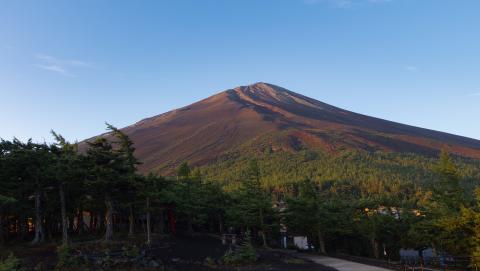
Yoshida Guchi Trail Nakano Chaya - Umagaeshi
Fujiyoshida Trail is one of the trails leading to the summit of Mt. Fuji. Many mountain climbers walk on this trail every year. However, unexpectedly, it is not well-known that you can start climbing at the foot of Mt. Fuji. There is the entrance in the precincts of “Kitaguchi Hongu Fuji Sengenjinja (Shrine)”, and you can climb on foot up to the summit of the Mt. Fuji. It takes 70 minutes from Fujiyosida trail to Nakano-chaya (shop). On the trail you will enjoy the colored leaves between Japanese red pines. The best time to visit is from late October to early November. Main kinds of trees: Japanese rowan, Fuji cherry and larch.
![]()
Lake Motosu locates at the edge of east side of Fuji Five Lakes and is 13km in circumference, 4.7 square kilometers in area, and 138 m in maximum water depth. It is deepest of the Fuji Five Lakes and also outstanding depth in the lakes in Japan. The clear azure water is magnificent and very transparent. Northern shore is the good place to view Mt.Fuji, which scenery was designed and printed on 1000yen bills. In autumn, beautiful colored leaves bright the lakeside and create a mystic atmosphere. Take photos with Mt Fuji in the background and walk round the Lake. The colored leaves around Fukkozan-Motosuko temple near the lakeside are wonderful too. Enjoy the untouched nature leisurely at the foot of Mt. Fuji ■The best time to visit is from late October to early November. Main kinds of trees: maple, cherry trees, Japanese rowan, beech and Lacquer trees.
![]()
The deepest and clearest of all the Fuji Five Lakes. Marine sports etc. It was famously featured on the old 5,000 yen banknote. Altitude: 902 m Surface area: 5.05 square km. Deepest point: 138 m Natural lake. Boat / Pleasure boat, etc.
![]()
The pale indigo blue waters and the surrounding Aokigahara Forest ‘sea of trees’ give the lake its mysterious charm. Fishing possible Altitude: 902 m Surface area: 2.12 square km. Deepest point: 71.2 m Natural lake Boat
![]()
Mt.Fuji, Misakayama series Mt. Fuji is the highest mountain which locates over Yamanashi prefecture and Shizuoaka prefecture, and one of the 100 most famous mountains in Japan. The conical (composite volcano) shape of the mountain is beautiful and there are no other mountains like Mt. Fuji which has been attracting many people through literatures, arts, and faith since ancient times. In summer, more than 200,000 climbers come to Mt. Fuji on Yamanasi side alone. On the summit, seeing the sunrise, “Goraiko”, and walking around the edge of a crater,”Ohachimeguri”, are very popular with climbers. 4 different trails are available starting from different entrances and more than half of climbers on all trails use Kawaguchiko trail and Yoshida trail on Yamanasi side. From 2009, Yamanashi and Shziuoka prefectures put the color-coded guide signs according to the prefecture, and the sigh of Kawaguchiko trail and Yoshida trail colored with yellow.
![]()
You can see a reversed Mt. Fuji reflected in the lake and the mountain with cherry blossoms, try fishing and lake sports, and see the lavender of early summer and the colored leaves in autumn. The data below is assuming a normal water level. (Data: Tsuru Construction Department) Altitude: 833 m Surface area: 5.78 square km. Deepest point: 21 m Natural lake Boat / Pleasure boat Contact: Fujikawaguchiko Town Tourism Association, Fujikawaguchiko Town Tourism Division 1700 Funatsu, Fujikawaguchiko-machi, Minami-tsuru-gun, Yamanashi Prefecture 401-0301
![]()
Fuji Marimo Moss Ball Habitat (Natural Monument) Marine sports, fishing etc. Altitude: 982 m Surface area: 6.67 square km. Deepest point: 15 m Natural lake Boat / Pleasure boat
![]()
The smallest of the Fuji Five Lakes. Crucian carp fishing, canoeing etc. Altitude: 902 m Surface area: 0.75 square km. Deepest point: 25.5 m Natural lake Boat
![]()
Diamond Fuji can be seen from Lake Yamanaka as the sun sets behind Mt. Fuji in twilight colors. It can be enjoyed over a long period from mid-October to late February, so it is recommended for those who are not early birds. It can be seen over a wide area of Lake Yamanaka. For details please contact the Yamanakako Tourist Association. (The place and times are on the linked website.) Time: Around 3:30pm – 4:30pm. (The times vary depending on the place and season.)
![]()
A nationally designated Natural Monument It was opened to the public in April 1998 and has lava stalactites and a ropy-lava bed. The cave has branch caves and the total is 350 meters long, which is the largest scale among lava caves at the foot of Mt. Fuji. Inside the cave, you can see stalactite and ropy-lava rock which were formed when the lava from Mt. Fuji’s eruption was exposed to air and got solid emitting gases. As it is not very cool in summer and is worm in winter inside the cave, which is different from other caves, many bats lived in the past for their hibernation. However, land developments and random trespassing brought the bats to the brink of extinction. Now, the cave is managed and the preservation area was placed in the back, so the number of the bat is growing little by little every year.
![]()
Oshino Hakkai is made up of eight spring water ponds. These eight ponds are spring-fed by water running down from the sacred Mt. Fuji, and have long been revered as ‘springs of the Gods’. Various legends have been passed down about the ponds. A long time ago Oshino-mura used to be a lake called Lake Utsu, however when Mt. Fuji erupted around 800 AD, the flow of lava split it into two, which became Lake Yamanaka and Lake Oshino. Lake Oshino was once related to the Fuji Five Lakes, but it dried up due to river erosion and drainage excavation. Oshino Hakkai exists from that time as ponds of the spring water that flowed down from Mt. Fuji. In 1985 the site was designated as one of the 100 best water sites in Japan due to the amount of water and its quality, its preserved state and its scenery. It is also a site of the 100 new views of Mt. Fuji and a nationally designated Natural Monument. The view of Oshino Hakkai and the view of Mt. Fuji from neighborhood are magnificent, which is popular with the people who like photographing.
![]()
This museum contains the works of the textile artist Itchiku Kubota who revived the traditional fabric dyeing technique of Tsujigahana. Tsujigahana flourished in Muromachi period and then disappeared just as suddenly. When Itchiku Kubota was 20 years-old, he was absolutely-fascinated with the beauty of the fabric dyeing and created his own contemporary style called Itchiku Tsujigahana. His works is highly-praised not only in Japan but also in foreign countries through exhibitions.
![]()
Lavender on the shores of Lake Kawaguchiko
In Jun, you will see the purple color of lavende near the shoreline of the lake or by the side of the road. The lavender plants are in full bloom in mid-Jun. Around the time of the bloom, the Kawaguchiko Herb Festival is held in the venues of three big parks in Fujikawaguchiko Town (Yagkisaki Park, Oishi Park, and Oike Park). You can enjoy the music performance of Jazz band, meeting crowns, and fireworks. You also buy plants of several kinds of lavender in that event. Enjoying the lavender during the day is nice, but you should take delight in the aroma of the flowers which are illuminated after sunset near the lakeside. Oishi Park is known as a photographing spot where you can take pictures of lavender with Mt. Fuji with its wide skirt, which is popular with people who like taking photos. The best time to visit: Late Jun through Early July
![]()
Lake Kawaguchiko Tenjoyama Park. A hiking course with 100,000 hydrangeas.
Mt. Tenjo, standing next to the shores of Lake Kawaguchi has an altitude of 1,075 m. The story ‘Mt. Kachi Kachi’ from Otogi Zoshi by the author Dazai Osamu was set here. The 100,000 hydrangeas on the side of Mt. Tenjo were planted by volunteers from Fujikawaguchiko Town in 1999. It is common for visitors to take the Mt. Tenjo Park 'Mt. Kachi Kachi' ropeway from the shores of Lake Kawaguchi to the top of Mt. Tenjo, then enjoy the hydrangeas on the 70 minute hiking course from the summit to the bottom of the mountain. The sight of the 100,000 hydrangeas blazing across the slopes from Nakabadaira 15 minutes down from the summit to the foot is spectacular. The best time to visit is from mid-July to early August.
![]()
In 864 (Tekan 6), Mt, Fuji had a historical major eruption. The lava covered the town spreading northern Mt.Fuji, and cut the big lake ‘seno-umi’ into pieces. The town was highly damaged by the lava. In the next year, an Imperial order was issued and people were dedicated to the Sengen shrine which is the god of Mt. Fuji , and held the ceremony for extinguishing the fire. It is more than 1000 years since the eruption, the shrine has been here to this day for worship of Mt. Fuji as a god. By the way, the lakes created from ‘seno-umi’ are Lake Saiko and Lake Shojiko. You can imagine how serious the lava flow was and the scale of the disaster. The god of the shrine is Sengen daijin ‘Konohana Sakuya Hime no Mikoto’. On April 25th ,the spring festival is held and on July 28th, Daidai Okagura Festivals designated by the prefecture, which practices the religious children’s dance ‘Chigo no mai”, is held. As the shrine is very historical, it has a lot of cultural property and giant trees stand in the site. Visit shrine and take a forest bathe. Come by yourself and then you will be relieved from the current time.
![]()
Seiryu no Sato(Home of Spring water) in Yamanakako Hananomiyako Koen(Flower Garden)
Seiryu no Sato (Home of spring water) locates in Hananomiyako koen. This is the place where all generations including kids or elder people can enjoy. The Pond “Kujiraga ike” was shaped like Yamanakako. At Iwashimizu water fall or Myojin water fall 80 cm wide and 100 meters high, you will feel the splash from the flowing down water. Feature of the place is the garden of the formed trees, and the observation and experience zone underground. These formed trees were made by the lava from the eruption of Mt. Fuji more than 1000years ago. Long time ago, trees growing in this area, were covered with a lava flow and left as wood molds. After you enjoy in the flower dome, you can go active at Seiryu no Sato under the blue sky.
![]()
The center is located at the entrance to Fuji Subaru Line and makes learning easy with the displays on the nature and culture of Mt. Fuji and the Fuji Five Lakes and provides a computer to search for information. A short story (10 minutes) titled ‘Fuji-san; Kokoro-no-Furusato’, plays on 12 large screens in Japanese, English and Chinese. The center also provides tourist information on the surrounding area and the prefecture. Please enjoy light meal at the observation restaurant and shopping at shops.
![]()
Kawaguchiko Muse Museum ,considered as a brunch of Kawaguchiko Museum of Art, opened in 1993 and holds the regular exhibitions on the works of doll maker Atae Yuki’s. Muse is the goddess of art in Greek mythology. The museum has the purpose that many people especially neighbors can enjoy and get familiar with the small Muses of Atae Yuki’s works, which are highly-praised even abrade, with the rich environment near Mt Fuji and Lake Kawaguchiko. The works made of cotton cloth are so well-crafted that they are praised as ‘cloth sculptures’. The exhibitions are changed twice a year, and there are around 80-90 on display at any one time. Time required: 20 – 30 minutes.
![]()
The Mt. Fuji Radar Dome is a symbol of meteorological observation in Japan and, now out of use, it has become an exhibition facility in Fujiyoshida City to spread the importance of meteorological observation.
![]()
Fujiyoshida Museum of Local History
Fujiyoshida city, which is the entrance of the Yoshida trail on Mt. Fuji, used to be crowded with pilgrims to Mt. Fuji. In recent years, the city flourished with in faith in Mt. Fuji and textile manufacture. The museum of Local History tells the history of this town quietly. Most of special exhibitions are about Mt. Fuji and the faith in Mt. Fuji, which have fulfilling pictorial records. Tokaidonature path goes through the garden and you can see the large size of Mt. Fuji from the observation room on the 2nd floor if the weather is nice. In the site, The house of old Miyashita family(cultural asset of prefecture), the house of Muto old Muto family(cultural asset of city), and the house of religious teacher ”Oshi” (Important cultural property of Japan/renovated) stand. In 2009, April, a little apart from the museum, another Oshi’s house, old Togawa-family’s house, was opened as an institution affiliated with the museum. Not only you can see equipments such as printing woodblocks and clothes concerning faith in Mt. Fuji, but also you will see and experience the life of the religious teachers and their residence used for lodgings for pilgrims.
![]()
An aquarium specializing in freshwater fish swimming in the clear spring water of Mt. Fuji. The exhibitions are centered on the aquatic life of Yamanashi’s rivers and lakes and fish cultivated within the prefecture. On the first floor there is a double-layered water tank, shore fish, deepwater fish, river fish, small creatures and a touch tank. On the second floor there is a theater, an open lab corner, a virtual fishing corner and a library corner. This area is developed as a ‘Sakana koen'equipped with walking trail, play gym, and a pond. Kids can freely play in this park. ‘Jabi Jabi pond’ surrounded by the sand that you can play in the water, biotope-style pond that you can observe the swimming fish, and the bird watching facility, at all these facilities, you can play and learn nature in the relaxing mood.
![]()
This is an art museum with the theme of Wachifield, a mysterious land created by Ikeda Akiko that is inhabited by Dayan the cat. Original pictures of Dayan the cat and others are on display, and dishes made with homegrown strawberries at the restaurant café ‘Olson-san no ichigo’ are very popular. There are other delicious café dishes, and the elegant space with high ceiling will provide you a special tea time that you usually do not have. Music concerts are held a couple of times a year, so you can enjoy the unconventional atmosphere created by the food and the music. Welcome to the mysterious world of ‘Wachifield'.
![]()
The museum was constructed for the 75th anniversary of Fujikyuko Co., Ltd together with the Horiuchi Koankai Foundation, and was completed in July 2003. It displays pictures of Mt. Fuji collected by both the organizations over a period of 40 years.
![]()
Tin Toy Museum in Kawaguchiko ‘Happy Days’
A white building on foot of Mt. Fuji on the shores of Lake Kawaguchiko is the museum of ‘Kitahara Teruhisa’ which exhibits his toy collection fro 40 years. The toys with the conception of ‘Things from Happy Days’, are on display. The toys are made with great care and you can feel the potential of Japanese craftsmanship. Even tiny parts are crafted finely including the fashion or looks of the people depending on the times. The place is filled with the passion of creativity. Tin toys like cars or airplanes, which were once exported to foreign country, are on display, and supplementary toys before the world warⅡtell us the magnificent world. You also see the dolls which used to be loved by girls or the interesting monsters in Showa period. It is not only nostalgic place, but alsothe place you will discover something new.
![]()
The best time to visit is from late October to early November. Main kinds of trees: maple, beech, cherry trees and Japanese rowan.
![]()
A nationally designated Natural Monument A circular vertical shaft.
![]()
Mt. Fuji Fuketsu Wind Cave / Motosu Fuketsu Wind Cave
A nationally designated Natural Monument Contains the most ice of all the caves at the northern foot of Mt. Fuji.
![]()
Okada Koyo (real name: Okada Kenjiro) was born on August 31st 1895 in Nakajo-mura (present day Tokamachi City), in Nakauonuma-gun, Niigata Prefecture. Koyo's great-grandfather Kihei (artist name: Kosetsu), grandfather Eizo (artist name: Undo) and father Ryusho (artist name: Koun) were all artists and left some outstanding works of calligraphy and art. Photographs taken by Koyo have been used many times on stamps and banknotes, and he promoted the image of Mt. Fuji, the mountain all Japanese hold dear to their hearts. Many people feel a sense of nostalgia when looking at Koyo’s Mt. Fuji.
![]()
An outdoor concert hall. Capacity: The outdoor concert hall can hold up to 3,000 people. The small indoor hall can hold up to 200 people. Sound, lighting, piano (extra usage charge) Parking: 700 spaces
![]()
The facilities can be used by amateurs and professionals for music camps, rehearsals and recordings, and top class musicians use the VICTOR Yamanakako Studio in the grounds.
![]()
Forest of Christmas / Santa Claus Museum
A fairy tale museum with the concept of cherishing the things that we cannot see. There are many things to enjoy at Japan’s largest Christmas spot which boasts a world Santa Claus collection and other collections of Santa, Christmas, fairies and angels separated by era, country and artist. Until July 20th: Open Friday, Saturday, Sunday and Monday. During Golden Week (April 29th - May 7th): Open daily. 9:00am – 5:30pm (Last admission: 5:00pm)
![]()
Japanese oak parent tree and parasitic species such as Japanese white pine and Northern Japanese Hemlock. Age: Over 300 years old.
![]()
Shibokusa Sengen-jinja Shrine 17 Japanese Yew Trees
A designated Natural Monument of the prefecture.